On Sunday, 30 August and 27 September, admission to selected guided tours at this site will be free of charge. Please obtain your free ticket in advance through the online booking system. Capacity for each guided tour is limited. On these special days, the following tours will be available: The Cistercian Monastery (basic tour) and The Metternich Residence.
Plasy Monastery Premises
The former Cistercian Abbey of the Assumption of the Virgin Mary
-
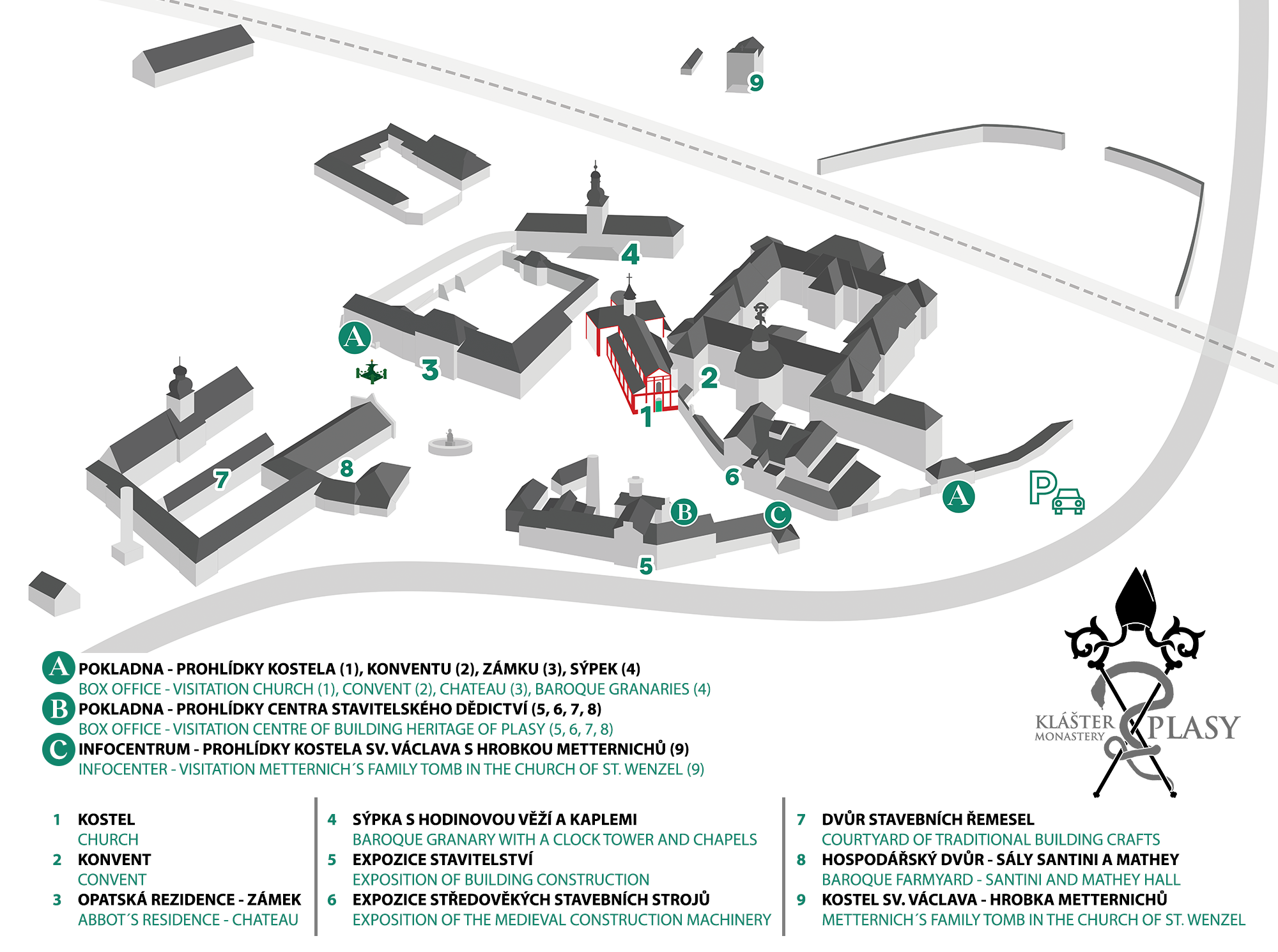
The ticket office and visitor facilities (A).
-
The Church of the Assumption of the Virgin Mary ① is the oldest preserved building of the monastery complex. Its present form dates back to 1661-1666. The originally Romanesque Basilica has never been significantly rebuilt, making the Plasy monastery church the only preserved pre-Gothic Cistercian sacral structure in Bohemia. The interior of the church dates back to the 17th and 18th centuries. Its decorations are the work of Škréta, Brandl, Starck, Willmann, Pink, Seeblumer, Raab and others.
The church is administered by the Roman Catholic parish of Plasy through the missionary monastic congregation of the Virgin Mary Immaculate. Its interiors are open to the public during masses and also as part of the main tour route of the monastery managed by the National Heritage Institute. -
The convent ② is a residential building designed for the needs of monks. The High Baroque form of this building is the work of the architect Jan Blažej Santini-Aichel. It was constructed between the years 1711 and 1740 on the site where the convent had stood since the Middle Ages; the present one, however, is much larger than its predecessors. Prominent artists of that time – Santini, Dientzenhoffer, Braun, Pink, Müller, Kramolín and others – were involved in the construction and decoration. The new convent was founded in the meander of the Střela River on approximately 5,100 oak piles holding an oak-beam grate which must be constantly underwater.
The Convent is under the administration of the National Heritage Institute and is a part of the main tour route of the monastery. The Study Repository of Furniture Funds is located in the second floor. -
The prelature ③ is a former representative residence in which the abbot received guests and where important negotiations took place. Its present appearance according to the design by Jean Baptist Mathey dates back to 1693-1698. After the former monastery was purchased by Klemens von Metternich, the interior layout of the building was changed to be used as a chateau. However, the Baroque art remained represented in the interior by a grand staircase with a marble railing and a ceiling decorated with a fresco as well as a large abbey hall with parquet floor, marble fireplaces and a rich stucco relief lining the ceiling painting entitled "The Church's Victory over Paganism" on the first floor.
The Prelature is managed by the National Heritage Institute. Its interiors are open to the public as the second tour route "Metternich residence". It also houses the ticket office and visitor facilities throughout the year. - The Baroque granaries ④ are located on the site of the original Přemyslid residence built in the second half of the 13th century. The three-storey gothic chapel of St. Wenceslas and St. Mary Magdalene is the only part of it that still remains. This unusual sacral structure became the basis used by Jean Baptiste Mathey to complete two wings of the massive baroque granaries with a clock tower in 1683-1686, where a functional clock dating back to 1686 is located.
The granary is managed by the National Heritage Institute and is open to the public as the third tour route.
- The brewery ⑤ with a mill underwent a Baroque reconstruction at the end of the 17th century and subsequent renovation after a fire in 1778. The mill wheels powered the milling equipment, an oil press, a grinder and a water pump. A saw was located on the opposite side of the mill race but was not preserved. The buildings of the brewery were transformed due to developments in beer brewing technology. The resulting form of the brewery dates back to the year 1900, when the whole brewery complex was modernised after a fire.
The Brewery is managed by the National Technical Museum and serves as a venue for the Center for Building Heritage, including its administration building. The interiors house an exhibition documenting architecture, its development, building materials and more. -
The lager cellars ⑥ were built on the site of an old malt house, which was damaged by a fire in 1894. They are new structures dating to the time of significant reconstruction of the Plasy brewery in 1900. A modern steam-brewery with a separate cooling area including a cooling room, a fermenting cellar and lager cellars was established, as well as a new malt house with a malt kiln. The last building served for soda production.
The lager cellars are managed by the National Technical Museum and are used by the Center for Building Heritage. The installation presents full-scale functional replicas of the machines, which have been created based on the study of historical sources and consistently manufactured using the craftsmanship of the period. On the ground floor, the private brewery "Knížecí pivovar Plasy" has been established and offers several types of beer brewed on site. -
The upper Courtyard of traditional building crafts ⑦ and the remaining buildings of the farm complex included a defensive tower, a dairy, barns, fishponds, and stables. The upper courtyard (with carriage sheds demolished in the 19th century that enclosed the monastery on the north side) features the Tower of St. Florian, which served as a bell tower.
This part of the complex is administered by the National Technical Museum and serves as a demonstration craft workshop for various educational programs within the so-called Building Crafts Yard. -
Since the Middle Ages, Baroque farmyard - Santini and Mathey hall ⑧ has been a counterbalance to the representative buildings intended for the spiritual life of monks or the representation of the abbot. The courtyard underwent a radical architectural transformation at the end of the 17th and in the middle of the 18th century. The main farm building, originally Romanesque, served as a granary, and after Baroque reconstruction, as the lord's office and staff apartments.
The farmyard is administered by the National Technical Museum and serves mainly as a hall for the Center for Building Heritage with an exhibition of architectural and historical research. The interiors of the lower courtyard house, among other things, the Municipal Library of Plasy.
- Metternich´s family tomb in the church of St. Wenzel ⑨ is originally a gothic building that was significantly rebuilt at the end of the 17th century by architect Jean Baptiste Mathey into a two-tower cemetery church outside the walls of the monastery complex. The church underwent its last major structural changes in the first half of the 19th century, when it was redesigned in the classicist style by architect Josef Ondřej Kranner (partly based on plans by Pietro Nobile) to serve as the Metternich family tomb.
The church is currently administered by the town of Plasy, which organizes regular tours through its Municipal Information Centre. The upper floor of the church is also used as a funeral hall.